

The choice between prefinished vs site finished material decides more than how a wall looks. It decides which trade eats the delay when it rains for a week, who owns a color mismatch across a 4,000-foot run, and whether a crew is painting trim or installing it. For millwork shops, lumber yards, and builders working the Front Range, that choice shows up on every production job.
We run production prefinishing out of a 13,000-square-foot shop in Englewood. Most of what we know about field finishing came from the boards that came back to us.
Also Read
Best Stain Systems for Cedar Siding in Colorado
TL;DR
Factory prefinishing applies coating to all six faces of a board in controlled conditions before it ships. Field finishing coats what's reachable after installation, usually the face only, under whatever weather the day gives you. The Western Red Cedar Lumber Association recommends prefinishing for that reason. Prefinishing wins on color consistency, coverage of the back and end grain, and schedule, because finishing happens off the critical path. Field finishing still makes sense for small quantities, final topcoats over factory primer, and touch-ups after install.
Key Takeaways
Factory prefinishing coats all six faces of a board, including the back and both ends, which is where moisture usually gets in.
The Western Red Cedar Lumber Association recommends pre-priming or prefinishing cedar before it reaches the job site.
Field-applied finishes cure under uncontrolled temperature, humidity, and dust, and the cedar industry names incorrect application as a top cause of coating failure.
Prefinishing moves finishing off the job-site critical path, so weather delays hit the shop schedule instead of the install schedule.
Field finishing still has a role for small runs, topcoats over factory primer, and sealing cuts made during installation.
On This Page
What Prefinished vs Site Finished Means on a Production Job
Prefinished vs Site Finished at a Glance
Why a Factory Finish Holds Up Longer
What Each Approach Costs You in Time
Where On-Site Finishing Still Makes Sense
The Hybrid Most Large Projects Use
Handling Prefinished Material on Site
Three Things That Decide Whether Prefinishing Pays Off
Five Questions to Ask a Finishing Shop
What Prefinished vs Site Finished Means on a Production Job
Prefinished material is coated in a shop before delivery. Site-finished material is installed raw, then coated in place.
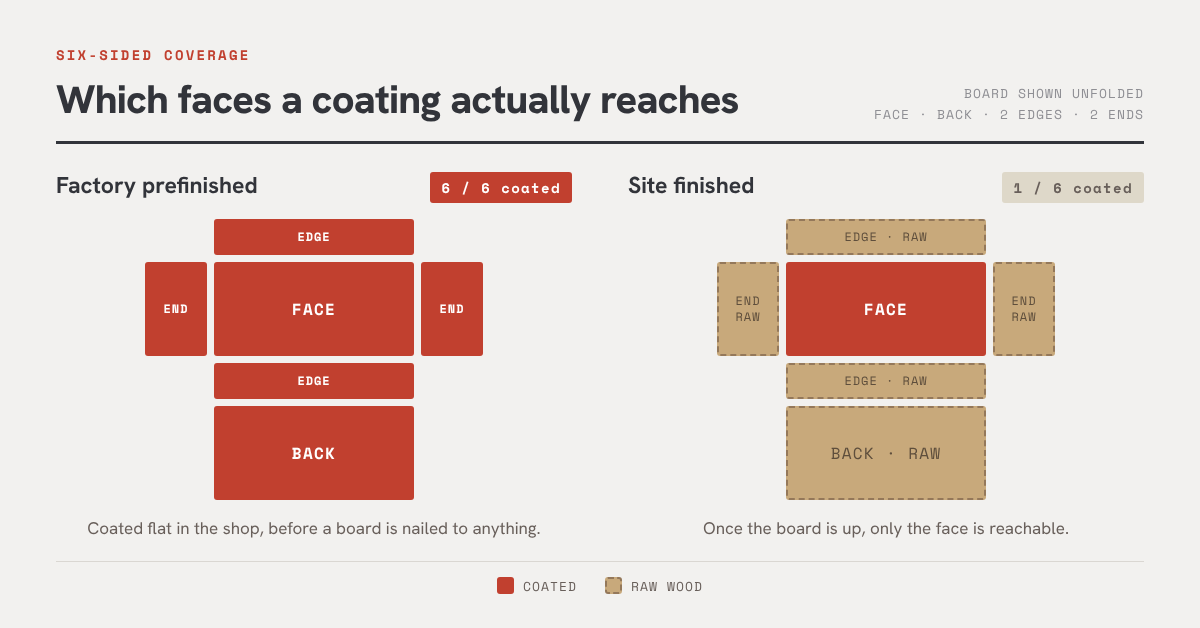
The practical difference is access. In a shop, a coater reaches every face of a board. Once that board is nailed to a wall, the back and the ends are gone for good, and only the face is reachable. The Western Red Cedar Lumber Association describes factory priming as a machine process that "applies a coating to all six sides of each board," and recommends pre-priming or prefinishing before job-site delivery for optimum performance.
Coverage is the strongest part of the argument. A board coated on one face is a board with five faces left open.
Prefinished vs Site Finished at a Glance
| Factor | Factory prefinished | Site finished |
|---|---|---|
| Faces coated | All six, including back and ends | Face, and whatever edges are reachable |
| Application conditions | Controlled shop temperature and humidity | Whatever the weather gives that week |
| Color consistency | Batch-controlled, documented formula | Varies by applicator, lap, and day |
| Schedule impact | Runs parallel to other trades | Sits on the critical path after install |
| Cut ends | Sealed in shop, field cuts resealed on site | Often left unsealed |
| Best fit | Production runs, repeat orders, large elevations | Small quantities, topcoats, touch-ups |
Verdict: for any run large enough to have a color-consistency risk or a schedule dependency, prefinishing is the stronger choice. Below that threshold, field finishing is simpler and the coverage gap matters less. Either way, wood is a natural material, so grain, density, and mineral streaking vary piece to piece, and a documented formula controls the coating, not the board under it.
Why a Factory Finish Holds Up Longer
Three things change when coating moves indoors.
Coverage. Back priming, the term for coating the wall side of a board, slows moisture pickup from behind the siding. A board sealed on one face can still take on water through the back and the end grain, and the finish on the face fails from underneath.
Conditions. A coating cures the way the air lets it. The Cedar Shake and Shingle Bureau's finishes guidance lists the top three causes of coating failure as improper preparation of the siding, incorrect finish application, and improper siding application. Two of those three are application problems, and both get easier to control in a shop.
Consistency. A color lab that documents a formula can rerun it next quarter. A crew matching by eye on a ladder can't.
None of this makes a finish permanent. The Canadian Wood Council is direct about it: coatings shield the surface for a time, they "do not actively protect against decay," and no coating lasts indefinitely. Prefinishing buys a better start and a longer interval, not an exemption from maintenance.
What Each Approach Costs You in Time
Price the two approaches on schedule as well as labor, because timing usually separates them.
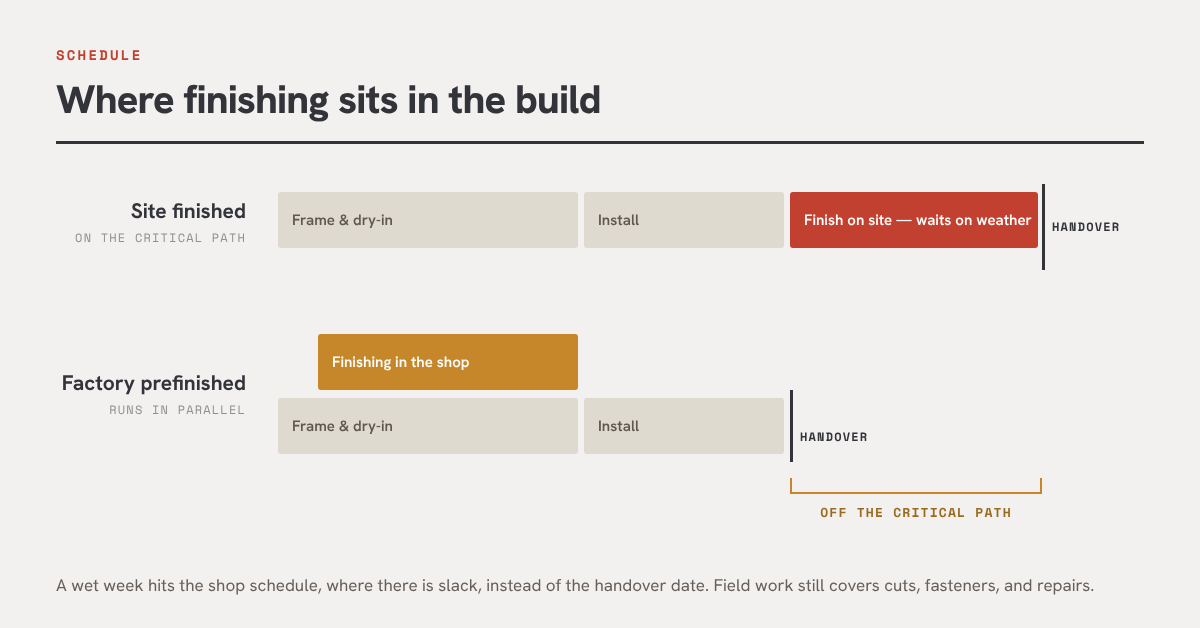
Field finishing sits between installation and handover. It needs dry weather, workable temperatures, and access to every elevation, often with staging. If the weather closes in, the finish waits, and so does everything behind it.
Factory finishing runs while framing, roofing, and windows are still in progress. Material arrives ready to install, and the installation crew installs, not paints. A wet week hits the shop schedule, where there's slack, instead of your handover date.
Where On-Site Finishing Still Makes Sense
Prefinishing isn't the answer to every job.
Small quantities. A few boards don't justify a shop setup and a delivery.
Final topcoat over factory primer. Some builders prefer factory priming on all six sides, then a field topcoat after install so fastener heads and seams disappear under one continuous coat.
Touch-ups and repairs. The crew fixes damage during install in place, every time.
Undecided color. If the color isn't approved yet and the material has to ship, priming now and topcoating later keeps the job moving.
The Hybrid Most Large Projects Use
In practice, the choice is rarely all or nothing. The common pattern on a large elevation is factory finishing for the bulk of the run, then a field kit for cuts, fasteners, and repairs, supplied from the same batch so the touch-up matches.
That keeps the coverage advantage where it counts, on the back and the ends of every board, while leaving the crew able to finish what installation inevitably changes. Ask the finishing shop for touch-up material from the same documented formula, not a retail color match.
Handling Prefinished Material on Site
A factory finish is only as good as the handling between the truck and the wall. Keep bundles flat, off the ground, covered against rain and direct sun, and ventilated so the stack doesn't trap moisture against the boards.
Primed material parked outside through a delayed schedule can need surface preparation again before the topcoat goes on, which erases part of what the factory step bought.
Three Things That Decide Whether Prefinishing Pays Off
On most jobs, it comes down to run size, schedule, and exposure.
Run size. The larger the run, the more color consistency and labor savings compound.
Schedule pressure. If finishing sits between install and handover, moving it into a shop takes a week of weather risk off the end of the job.
Exposure. South and west elevations, high altitude, and snow-reflected light all shorten a finish's life, which raises the value of full coverage and a controlled cure.
If two of the three apply, prefinishing is usually the better call.
Five Questions to Ask a Finishing Shop
These five separate a shop that runs production from one that paints to order.
Do you coat all six faces, including the ends? If the answer is face and edges, the main durability advantage is already gone.
Do you document the formula? Repeat orders and repairs depend on it, and a shop working from memory can't match a wall built last year.
What moisture content do you finish at, and do you measure it? Finishing wet wood fails regardless of how good the coating is.
What equipment runs my profile? A flood coater, an automated trim line, and a spray booth each suit different work, and the answer tells you whether your run is routine for them.
Do you supply matching touch-up material? The crew will need it on install day, and a retail can matched by eye won't hold.
Spec Your Next Run With the Finishing Shop, Not After It
Most of the friction in prefinishing comes from specs that arrive late or incomplete. Bring the material, species, profile, quantity, and the approved sample to the conversation early, and the shop can schedule around your install date instead of behind it.
We prime interior millwork, trim, and panels, and we prefinish exterior siding and cladding for millwork shops, lumber suppliers, and contractors across Denver and the Front Range. Send your project details and we'll tell you what we need to quote it.
-
For most production work, yes. Factory finishing coats all six faces in controlled conditions, and the WRCLA recommends pre-priming or prefinishing before job-site delivery. Site finishing can only reach the face once the board is installed.
-
Back priming is coating the wall side of a siding board before it goes up. It slows moisture pickup from behind the board, which is a common cause of finish failure on the face.
-
Yes. Every exterior coating needs periodic reapplication. Prefinishing extends the interval and improves the starting condition.
-
WRCLA guidance notes primers generally aren't intended to weather more than 90 days before a topcoat goes on. Keep primed material dry, covered, and out of direct sun until it's installed and coated.
-
Reseal every field cut with primer before the piece is installed. Exposed end grain absorbs water faster than any other surface on the board.
-
Yes, and many builders prefer it. Factory priming on all six sides plus one field topcoat gives full coverage behind the board and a continuous film over fasteners and seams. Order touch-up material from the same documented formula so the field coat matches.
-
It moves cost instead of removing it. You pay a shop instead of a field crew, and you avoid the costs that show up when finishing goes wrong on site: rework on failed coating, delays while a wall waits for a dry week, and callbacks on color variation. Whether the trade is favorable depends on run size, access, and schedule, so price it per job.
-
On coverage, yes. A factory line coats all six faces, including the back and both ends, where moisture usually gets in, and the coating cures in controlled temperature and humidity. A field finish reaches the face and whatever edges are still accessible after install. Neither one is permanent, and both need periodic reapplication.
-
It comes down to volume and consistency, not capability. A shop with steady throughput, booth capacity, and a finisher on staff has good reasons to keep the work. Outsourcing earns its place when finishing is the constraint on everything else: when the booth is the bottleneck, when color has to hold across a long run or a repeat order, or when the volume arrives in bursts the shop cannot staff for.
About the Author
Maddin Mendiola is Operations Manager at Colors Finishing in Englewood, Colorado, where he oversees production scheduling, estimating, customer coordination, and daily shop operations. His work connects custom finish requirements with production runs for millwork companies, lumber suppliers, and contractors across the Front Range.
